

Table of contents
On 1 September 2026, Anthropic released Claude Fable 5.1, a new version of its top model. The same day brought Claude Mythos 5.1, which is essentially the same model with a different set of safeguards, kept for verified organisations in cybersecurity and life sciences.
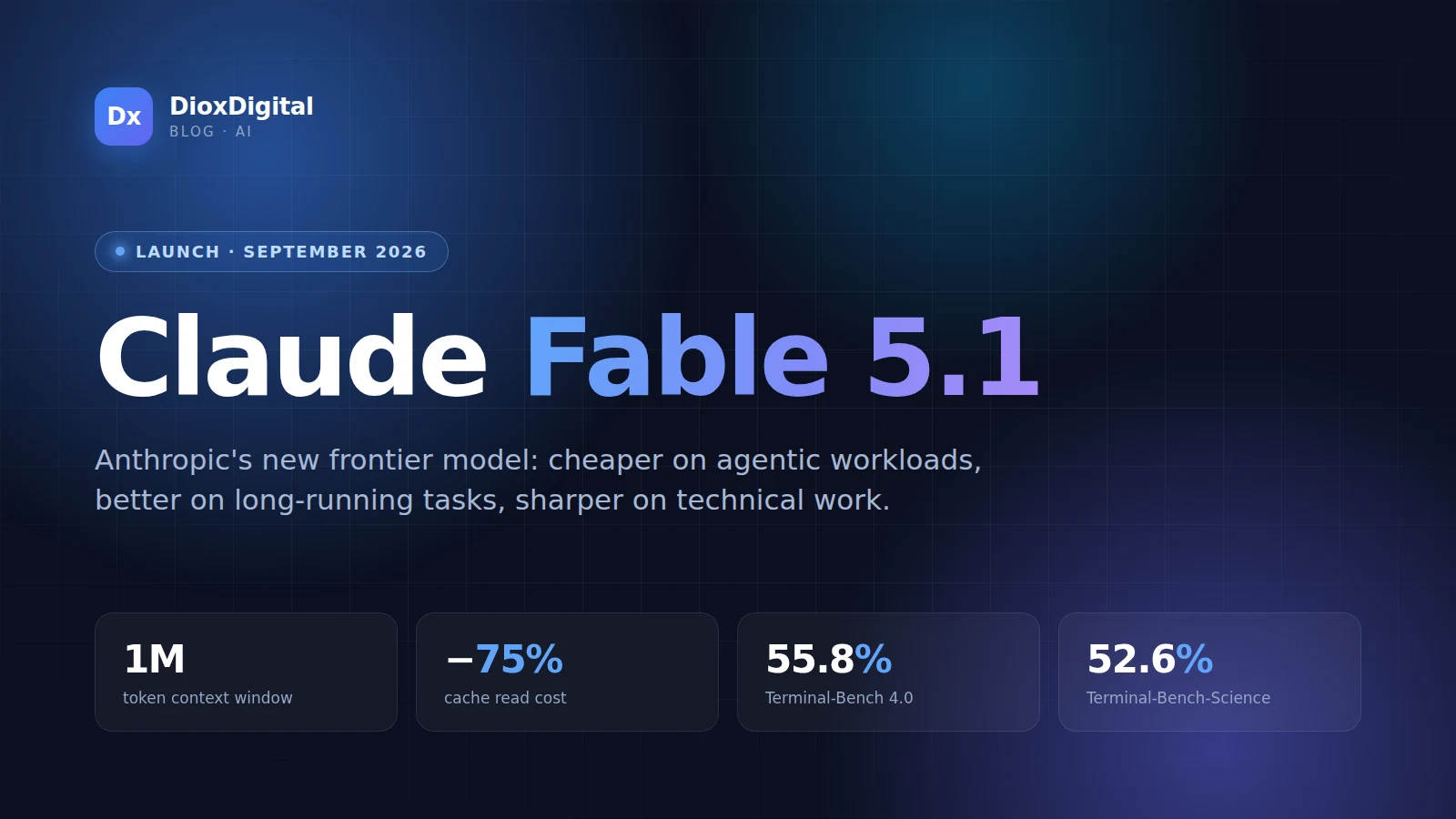
Base prices stayed where they were. Two things did change: cache reads now cost 75% less, and on long, technical tasks the model is noticeably better than before. Below are the numbers, and at the end the part that matters most if you use AI in your business.
The specs, briefly
- Model ID: claude-fable-5-1
- Context window: 1 million tokens
- Max output: 128,000 tokens
- Knowledge cutoff: June 2026
- Reasoning: adaptive, always on
- Release date: 1 September 2026
How much better it got
The figures below are the ones Anthropic published. The biggest jump shows up on scientific tests and on tasks run in a terminal, which is exactly where the model works on its own, step by step, for tens of minutes or even hours.
- Terminal-Bench-Science 0.1: 52.6% (Fable 5: 24.7%, Opus 5: 29.0%)
- Terminal-Bench 4.0: 55.8% (Fable 5: 42.0%, Opus 5: 52.3%)
- CursorBench 3.2.0: 73.4% (Fable 5: 70.5%, Opus 5: 70.0%)
- Humanity's Last Exam, no tools: 60.9% (Fable 5: 57.8%, Opus 5: 56.6%)
- AutomationBench: 31.4% (Fable 5: 17.1%)
The Terminal-Bench-Science score more than doubled compared to the previous version, and AutomationBench went from 17.1% to 31.4%. All of these tests really measure one thing: whether the model carries a task through to the end or loses the thread halfway.
On the research side, Anthropic shared a few concrete examples. Protein binders designed with ten times better binding affinity than the reference, at a 50% hit rate across 12 targets. GPU kernel optimisations that delivered 2.5x speedups. And a high-resolution elevation map of Venus, built from Magellan radar data.
Pricing, the part you notice fastest
- Input: $10 per million tokens
- Output: $50 per million tokens
- Cache write, 5 minutes: $12.50 per million
- Cache write, 1 hour: $20 per million
- Cache read: $0.25 per million, down from $1 on Fable 5
- Batch API: half price on input and output
The idea behind caching is simple. The fixed part of the prompt, meaning your documentation, internal procedures, code or a client's context, gets paid for once when it is written, then re-read very cheaply on every run. If you have an automation that fires dozens of times a day from the same context, that is where most of the bill goes.
Anthropic estimates roughly 25% lower cost on ordinary workloads and up to 45% on agentic ones, which lean heavily on reused context. If you run automations daily, that matters more than any extra benchmark point.
Fewer pointless refusals
Part of the release is about the model's safeguards. Anthropic says unnecessary interventions in the cybersecurity area dropped by around 60%, and defensive work is now explicitly allowed, including looking for vulnerabilities in your own systems. Mythos 5.1 is the same model with different thresholds, and stays reserved for US organisations vetted through Anthropic's programmes.
Two other things here are useful for companies. First, Enterprise Frontier Safeguards, which let monitoring data stay inside the customer's own cloud infrastructure. Second, invisible watermarking of generated text, for EU AI Act requirements.
What this means for a small or mid-sized business
- Automations can run longer without you watching them. The gap on terminal-style tests shows up as tasks that actually reach the end: document processing, repetitive checks, reports pulled together from several sources.
- Cost drops where you reuse the same context. If every run starts from the same procedures or the same knowledge base, cheap cache reads seriously change the economics of the process.
- It is not the right model for instant chat on your site. It runs at high effort by default and answers more slowly. For real-time interactions, the fast and cheap models are still the better fit.
- A 1 million token context will not tidy up your data. You can load a whole folder of documents, but the output is only good if those documents are correct and structured.
- Without a clear process, nothing changes. A better model speeds up a workflow that already exists. It will not invent one for you.
Where you can use it
Fable 5.1 is available in the Claude apps and in the API, under the ID claude-fable-5-1. You will also find it on Amazon Bedrock, Google Cloud Vertex AI and Microsoft Foundry. Mythos 5.1 stays limited to verified organisations.
What to keep an eye on
- Output costs $50 per million tokens. In an automation, response length has to be capped from the start, otherwise the bill grows quietly.
- Latency is higher than on the fast models. Do not put it in the path of an interaction that has to answer in two seconds.
- Benchmark results are not your results. Test it on two or three real workflows before you move everything over.
- The model's knowledge stops in June 2026. For anything current it needs web search or your own data.
Conclusion
Fable 5.1 does not change the rules of the game. It is a better and cheaper version of the same thing: a model built for long tasks it can finish on its own. If you already run automations, the main gain is cost per run. If you do not, the model itself solves nothing, because the first step is still the same: look at the repetitive work in your business and decide what is worth automating.
Let's talk about AI automation
Sources: Anthropic's official announcement and the Claude Platform documentation.